When the rear end needs to be locked for a hairpin, a drift entry or a quick change of direction, it is immediately noticeable whether the braking solution is right for the build. The question of hydraulic handbrake or cable handbrake is not just about how hard it brakes. It determines the feel in the lever, how easy the car is to control and whether the car still functions as intended on the street, track or rally course.
There is no one-size-fits-all solution. A hydraulic handbrake provides fast and aggressive response when every tenth and every angle counts. A cable handbrake is mechanically simple, reliable, and often more relevant in a street car. Choose based on how the car will actually be driven – not just what looks right in the garage.
Hydraulic handbrake or cable handbrake – the real difference
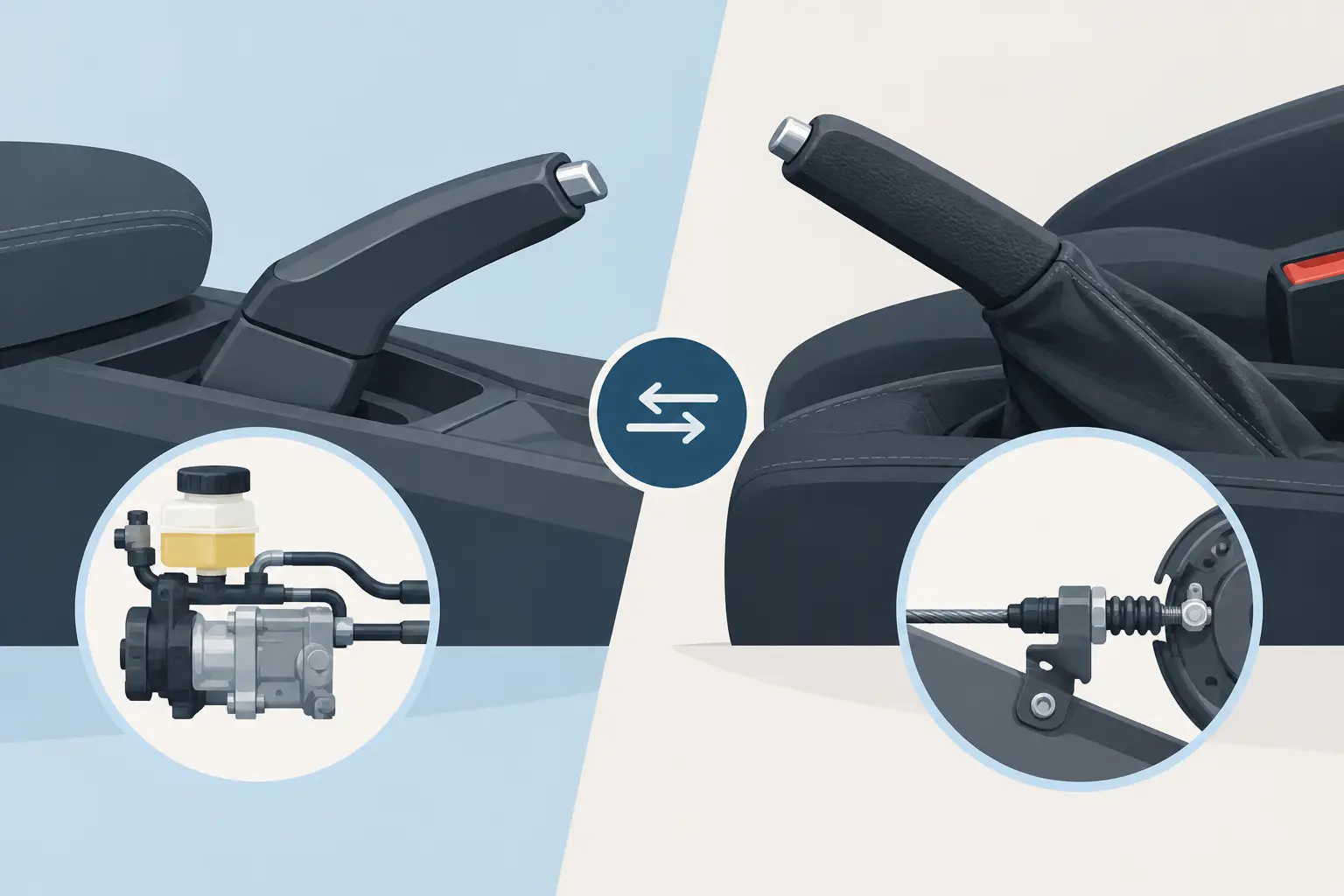
A cable handbrake works mechanically. When you pull the lever, the cables that activate the brake mechanism are pulled to the rear, either in the caliper or in a separate handbrake drum, depending on the car's design. The force goes from your hand to the brake without brake fluid, a master cylinder or additional hydraulic lines.
A hydraulic handbrake instead uses a separate master cylinder. When the lever is pulled, hydraulic pressure builds up in the brake line to the rear axle. The result is typically a much more direct braking effect than with a cable, especially when the system is properly sized and properly bled.
It is the direct response that has made hydraulic handbrakes a given in many drift and rally builds. But the high performance also means that assembly, brake balance and regulations must be taken seriously. Simply putting a long lever in place and connecting it to existing brakes is rarely a well-thought-out solution.
When a hydraulic handbrake is the right choice
In drifting, you want to be able to lock the rear wheels immediately, even when you're on the gas and need to correct the car's angle. Here, hydraulics are hard to beat. The lever provides short travel, fast pressure build-up, and a braking action that's easy to repeat once the driver has built in the right feel.
The same applies to many rally applications. In tight hairpins, a hydraulic handbrake can help the car rotate without you having to overload the front end or make unnecessary large steering turns. On a real race car, it is part of the whole along with the chassis, tires, brake pads and brake balance.
Advantages of hydraulics
The big win is responsiveness. A properly built hydraulic solution can lock the rear wheels quickly and consistently, with less lever movement than a cable solution. This makes it effective when you need a clear tool to position the car.
Hydraulic systems also give you more freedom in component selection. You can use a separate rear caliper solution, choose the master cylinder as needed, and build the braking system for the driving you want the car to handle. For many builds with larger brakes or a rebuilt rear axle, it is easier to create the correct function hydraulically than trying to adapt the original cables.
Disadvantages you shouldn't overcome with optimism
Hydraulics require more precision. The diameter of the master cylinder, the caliper piston area, the wiring and the system design affect both power and feel. Too large a master cylinder can give a stiff lever with too little mechanical leverage. Too small can give a long stroke and a lever that goes too close to the end position.
Air in the system ruins the feel right away. A spongy handbrake is not only frustrating on the track – it makes the car difficult to drive consistently. Use quality couplings, the right brake pipe or hose, and build with serviceability in mind. Brake fluid, heat, and vibration are bad friends with half-baked assemblies.
A hydraulic handbrake is also not automatically suitable as a parking brake. Hydraulic pressure can change as the system cools, leaks minimally, or is loaded over time. Therefore, a street car should normally have a separate, functioning mechanical parking brake even if it has a hydraulic handbrake for motorsport.
When the cable handbrake is the smarter choice
The cable handbrake sometimes gets an undeserved bad rap in performance circles. On a street car, it's often just the thing. It's simple, mechanical, and built to hold the car still when parked. You don't have to worry about pressure drops, extra master cylinders, and how a modified brake system affects inspections or everyday use.
A fresh original handbrake can work surprisingly well if given the right conditions. New cables, fresh calipers or pads, correct adjustment and clean contact surfaces make a big difference. Many problems described as a “weak handbrake” are actually worn cables, binding mechanisms or brake parts that have never been adjusted correctly.
For easier track driving, a cable handbrake can also go a long way, especially if the purpose is not to initiate skidding but to have a secure parking function and a near-original braking system. It usually provides less immediate locking force than hydraulics, but that is not always a disadvantage. A less aggressive function can be easier to handle on slippery surfaces and more forgiving in a car that is driven on the road every week.
Choose by discipline, not by trend
For drifting, a hydraulic handbrake is often the natural choice. Prioritize a rigid mount, a lever location you can reach without relinquishing control of the steering wheel, and a system that can be serviced quickly between driving sessions. Many serious drift builds use separate rear calipers for the handbrake. This way, the handbrake doesn't affect the function of the footbrake in the same way, and the system is easier to fine-tune.
For rallying, the choice depends on the car class, regulations and ambition level. Hydraulics are common when hairpins and fast rotations are an important part of the driving, but the design must fit the rules of the series you are driving. Always check the current regulations before ordering parts or rebuilding the brake system.
For trackday and street use, a well-functioning cable handbrake is often the most rational option. Spend your budget on pads, brake fluid, cooling and tires if your goal is better braking performance over an entire session. A handbrake rarely makes the lap time alone, while a braking system that can handle lap after lap makes a big difference.
Build the brake system as a system
The most common mistake is to see the handbrake as a separate part. It is part of the car's overall brake balance. If you change the calipers, discs, pads or master cylinder, the function of the handbrake can change significantly, even if the lever itself is the same.
With a hydraulic handbrake, you need to decide whether to connect it in series with the rear brake circuit or get a separate solution with its own calipers. A series-connected design can be compact and common in some builds, but requires that everything works together without giving unwanted pedal feel or imbalance. Separate calipers cost more and require space, but provide clearer separation between the foot brake and handbrake.
The location of the lever also matters. A vertical lever often provides quick access in drift and rally, while a horizontal solution may be better suited to a more discreet street or trackday build. The important thing is that the mount is in a real structure, not in thin sheet metal or a plastic bracket. A handbrake that moves in the mount gives a worse feel and is completely wrong on a car that is driven hard.
Don't forget the brake fluid. When driving hard, use a fluid with properties that match the temperatures the car is exposed to and change it regularly. Also, check that hoses and pipes are routed away from heat, sharp edges and moving parts.
Street legality and safety come before shortcuts
On a car used on public roads, the parking brake must function according to the requirements that apply to the vehicle. A hydraulic handbrake does not automatically replace the mechanical parking brake. If you are building a street car, it is wise to retain or restore a functioning cable solution for parking, even if the car gets a separate hydraulic lever for track driving.
Also check what applies to modifications to the brake system, registration inspection and your competition class. Rules can differ between car type, model year and organizer. Brakes are not a category for guesswork. If you are unsure about sizing, component selection or assembly, personal support before purchase is cheaper than rebuilding the same system twice.
House of Motorsport is aimed at builds that will withstand real driving, so think all the way from calipers and master cylinders to clutches, hoses and mounting. The right parts are only half the job – how they are matched determines whether the car feels sharp or difficult to drive.
If the car is going to attack clipping points or hairpins, build hydraulically with the right margins and a clear plan. If it is going to work every day and be safely parked, give the cable handbrake the love it deserves. The best solution is the one you can rely on when the temperature rises, the tires are hot and the next braking leaves no room for hesitation.